CONNECTED OPERATIONS
Your Existing Systems Become Part Of The Mission.
Integration — Connecting the Systems You Already Use
Drone Command One (DC1) is designed to integrate with the systems, sensors, applications, and technologies organizations already use.
Most organizations do not need another standalone application.
They already have security systems, cameras, access control, alarms, dispatch systems, mapping applications, databases, sensors, analytics platforms, mobile devices, and specialized operational software.
The problem is that many of these systems operate independently.
DC1 provides the orchestration layer that can connect them.
An Integration Platform — Not an Island
DC1 is designed around an open integration philosophy.
Using APIs, web services, database interfaces, cloud services, and other supported integration methods, DC1 can exchange information with external applications and use that information to initiate operational workflows.
An external system can generate an event.
DC1 can receive that event, evaluate it against established rules, alert the appropriate personnel, create an assignment, dispatch an authorized drone or other resource, track the response, escalate when necessary, and document what happened.
DC1 can also send information back to other authorized systems.
This creates a coordinated environment where systems do not simply collect information—they can help initiate action.
Security & Access-Control Systems
DC1 can be integrated with security applications such as access-control systems, intrusion detection, perimeter sensors, alarm systems, and video-management platforms.
Consider a perimeter security system that detects a possible intrusion.
Instead of simply generating an alarm for someone to investigate, that event could be passed to DC1.
DC1 could initiate a predefined response workflow, notify security personnel, create an incident, and—when authorized and operationally appropriate—dispatch a drone to a predetermined location or flight plan.
The drone's camera or sensor information can provide additional situational awareness while security personnel respond.
Detection becomes coordinated response.
Cameras, Sensors & IoT Devices
Organizations increasingly operate networks of cameras and intelligent sensors.
DC1 can serve as an orchestration layer between these devices and the people responsible for responding to what they detect.
Potential integrations could include:
• Fixed security cameras and video-management systems
• Thermal and infrared cameras
• Motion and perimeter sensors
• Environmental monitoring systems
• Fire and smoke detection
• Weather monitoring
• Industrial sensors
• Building-management systems
• Radar and other detection technologies
• IoT devices and intelligent edge sensors
A sensor does not necessarily need to understand the entire response process.
It simply needs to tell DC1 that something happened.
DC1 can determine what happens next based on the organization's established workflow.
Drone & Autonomous-System Integration
DC1 is designed so drones are part of the operational environment, not isolated equipment requiring an entirely separate process.
Through supported manufacturer APIs and interfaces, DC1 can integrate drone and dock capabilities into broader workflows.
A mission could begin because an operator manually requests it, but it could also begin because another authorized system detected an event.
For example:
Sensor detects an event → DC1 receives the alert → DC1 creates an incident → personnel are notified → an authorized drone mission is initiated → imagery and sensor information are returned → responders receive updated information → the event and response are documented.
The drone becomes another operational resource available to the organization.
GIS, Mapping & Location Services
Location is critical to security, emergency response, public safety, infrastructure management, and autonomous operations.
DC1 can be integrated with mapping, GIS, GPS, and other location-based technologies to provide geographic context to an incident.
Locations can be associated with personnel, facilities, incidents, sensors, drones, flight plans, assets, and response assignments.
This helps transform individual data points into a common operational picture.
Dispatch, Communications & Notifications
DC1 can integrate communications into operational workflows so important events do not depend entirely on someone watching a screen.
Depending upon the organization's requirements and available interfaces, integrations can support technologies such as email, SMS/text messaging, mobile notifications, dispatch applications, and other communications platforms.
Personnel can be notified when an assignment is created, acknowledge the assignment, provide status information, and indicate when the task has been completed.
This creates continuous operational workflow from detection through response and resolution.
Analytics, Dashboards & AI
Information collected through DC1 does not have to remain inside DC1.
Operational data can be made available to authorized analytics and reporting platforms for dashboards, performance measurement, historical analysis, and management reporting.
Likewise, AI and machine-learning applications can become another source of information within the DC1 environment.
An AI application might analyze video, imagery, radar, or sensor information and identify something requiring attention.
DC1 can then turn that detection into an operational response.
AI identifies. DC1 orchestrates. People remain in command.
Edge, Cloud & On-Premises Technologies
Different organizations have different security, performance, and connectivity requirements.
DC1 can be architected to work with combinations of cloud, on-premise, mobile, and edge technologies where supported.
Edge computing can be particularly valuable when information must be processed close to the drone, camera, radar, or sensor rather than continuously sending large amounts of raw data to the cloud.
This can reduce latency and allow important information to reach DC1 more quickly.
Integration Is Where Orchestration Becomes Powerful
The real value of integration is not simply moving data between applications.
It is determining what should happen because of that data.
- A camera detects something.
- A sensor generates an alarm.
- An AI model identifies an object.
- A radar detects movement.
- An employee reports an incident.
- A dispatcher receives an emergency call.
- Any of these can become the beginning of a DC1 workflow.
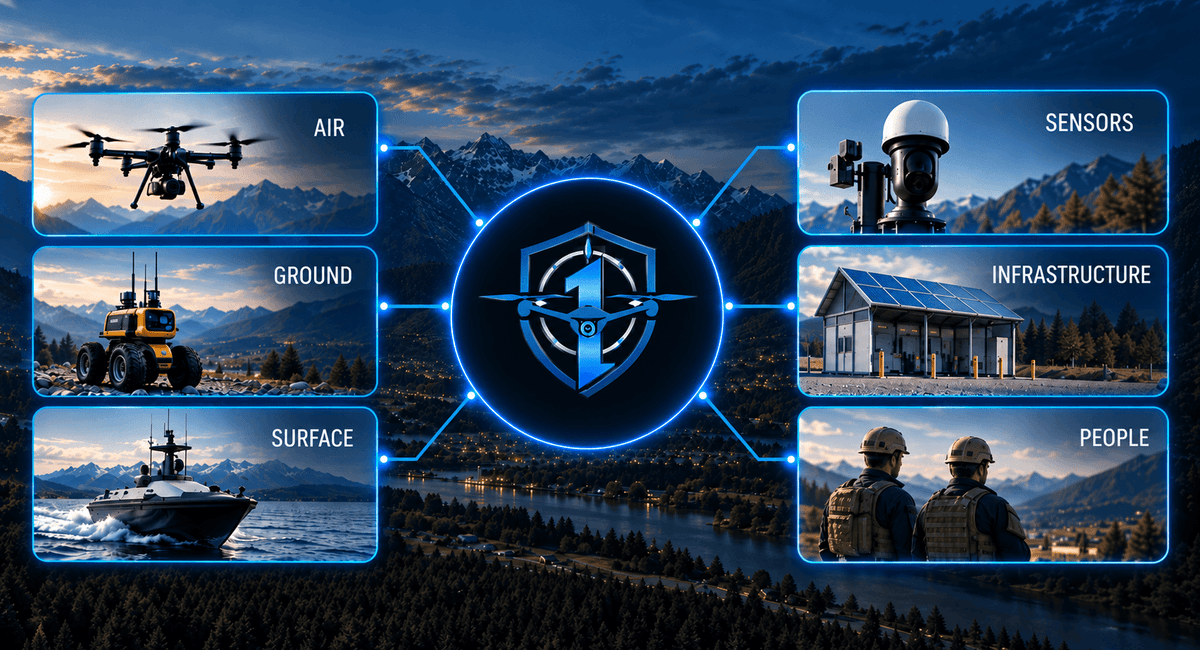
From there, DC1 can help coordinate people, drones, autonomous systems, sensors, communications, applications, and established procedures as part of a unified response.
Keep the Systems That Work. Connect Them to DC1
Organizations have already invested heavily in technology. DC1 is not intended to force customers to discard those investments.
Instead, DC1 can become the orchestration layer between existing systems and the people responsible for taking action.
Connect your systems. Connect with your people. Connect your autonomous assets.
Drone Command One brings them together, transforming disconnected technologies into a coordinated operational environment.
Connect The Systems You Already Use.
The architecture is intended to complement existing operational technology, not force organizations to replace it.

Autonomous Platforms
Drones, UGVs, autonomous surface vehicles and specialized robotic systems.

Docks & Charging
Remote launch, recovery, charging and readiness infrastructure.

Video Management
Security cameras, mobile video, aerial video and thermal feeds.

CAD / Dispatch
Connect public-safety events and calls for service to mission workflows.

Access & Alarm Systems
Use physical-security events to initiate or inform response missions.

GIS / Mapping
Put mission assets and incidents into a shared geospatial context.

IoT & Sensors
Ingest environmental, perimeter, radar and specialized sensor data.

Enterprise Systems
Connect reporting, workflows and operational data through APIs.

AI Services
Use machine intelligence for detection, prioritization and decision support.
A R C H I T E C T U R E P R I N C I P L E
Integrate Once. Orchestrate Everywhere.
Adapters and APIs can normalize diverse platforms into a common mission model, making workflows less dependent on any single equipment manufacturer.