MISSION - CRITICAL OPERATIONS
Autonomous Mission Coordination Across Domains.
Drone Command One (DC1)
Autonomous Mission Orchestration for Defense Operations
Drone Command One (DC1) is a mission orchestration and command-and-control platform designed to coordinate personnel, autonomous systems, sensors, intelligence, and operational workflows within a unified environment.
DC1 goes beyond controlling a drone. It provides the orchestration layer connecting the people, unmanned systems, sensors, information, and response procedures required to execute a mission.
From routine installation security to complex autonomous missions, DC1 is designed to help military organizations detect, assess, coordinate, respond, document, and continuously adapt to events in the operational environment.
Installation and Perimeter Security
DC1 can augment military police, security forces, and installation personnel with scheduled and event-driven autonomous patrols.
Drones can patrol fences, gates, flight lines, storage areas, ammunition facilities, critical infrastructure, restricted areas, and other designated locations.
Using visible light, infrared, thermal, and on-board radar, DC1 can assist in identifying people, vehicles, objects, abnormal heat signatures, or other conditions requiring investigation.
When an event is detected, DC1 can record the event, preserve imagery and sensor information, alert personnel, initiate an established response workflow, and dispatch appropriate resources.
Autonomous Drone Missions
Field operators can create predefined missions using waypoints, altitude, speed, patrol areas, and other mission parameters using mobile devices.
Once an approved mission is transferred to the aircraft, supported systems can execute the flight autonomously from takeoff through the programmed mission and return-to-land sequence.
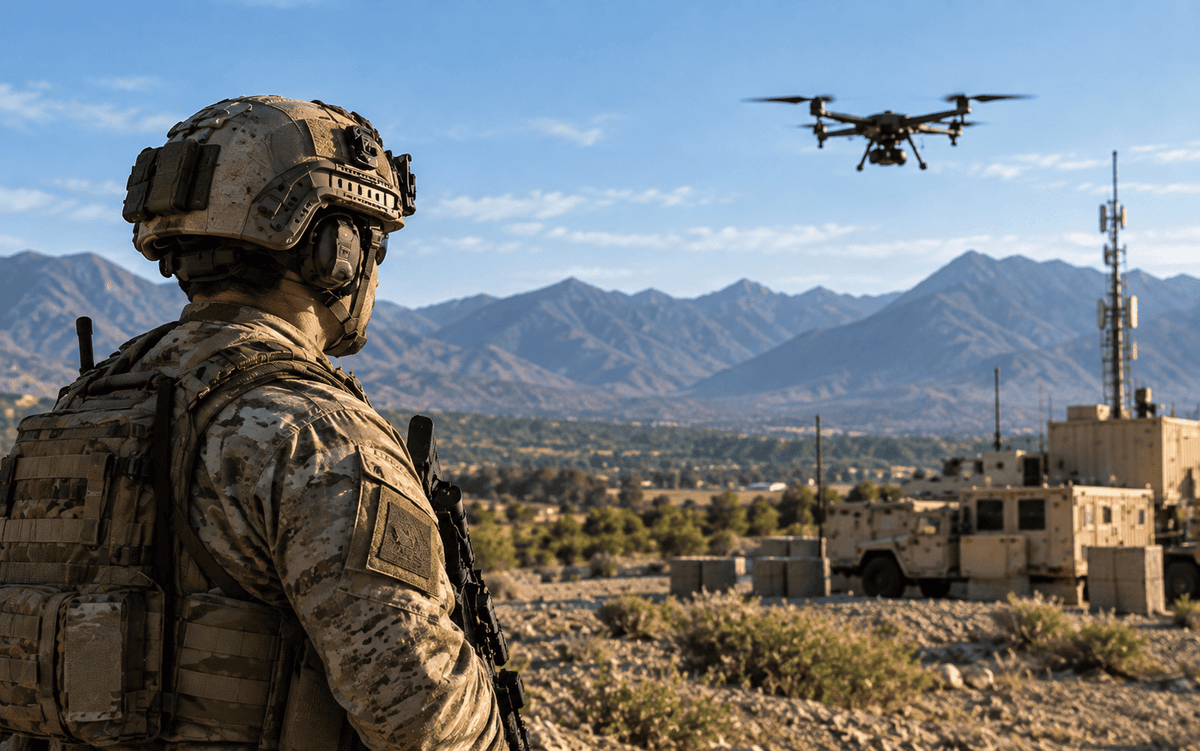
This allows repetitive missions such as perimeter patrol, infrastructure inspection, reconnaissance, surveillance, and area monitoring to be performed consistently while personnel remain focused on higher-level mission decisions. DC1 can take the “point” on patrols, providing real-time video feed to the ground units.
Multi-Drone Operations
DC1 is being designed around coordinated autonomous operations rather than a single aircraft.
Multiple drones can be assigned different responsibilities within the same mission. One aircraft might conduct a perimeter patrol while another monitors a gate, provides overwatch, investigates an alert, or maintains observation of an identified area.
When one drone detects an event, the orchestration layer can support coordination of additional unmanned assets and personnel based upon mission rules and operator authorization.
This creates the foundation for increasingly collaborative autonomous operations.
Command and Control
The DC1 orchestration layer provides commanders and authorized personnel with a common operational environment for managing missions.
Rather than operating personnel, drones, sensors, alerts, and procedures as independent systems, DC1 brings them together into a coordinated operational workflow.
A commander can determine:
- What happened?
- Where did it happen?
- What assets are available?
- Who has been notified?
- What response procedure applies?
- What actions have already been taken?
- What should happen next?
DC1 can then help coordinate the resources necessary to execute that response.
Personnel and Team Management
DC1 is not limited to unmanned systems.
The underlying workflow platform can schedule, assign, dispatch, and track personnel and teams. Routine patrols, inspections, guard assignments, emergency procedures, maintenance activities, and other operational tasks can be assigned and documented.
Personnel can receive assignments and notifications through mobile devices, acknowledge tasks, report status, and document completion.
This allows human and autonomous resources to operate as parts of the same mission workflow.
ISR and Situational Awareness
DC1 can support Intelligence, Surveillance, and Reconnaissance missions by coordinating autonomous aircraft and their sensor payloads.
Depending upon the aircraft and payload, information can include:
• Visible-light imagery and video
• Infrared and thermal imagery
• Object and vehicle detection
• Geolocation information
• Radar information
• Environmental sensors
• Gas or hazardous material sensors
• Other mission-specific sensor data
The objective is not simply to collect more data. DC1 is designed to help transform sensor observations into operationally useful information and coordinated action.
AI-Assisted Detection and Analysis
Artificial intelligence can be incorporated into DC1 to assist with analyzing camera and radar tracking information.
AI-assisted capabilities can help identify objects, vehicles, people, unusual conditions, changes in an area, or other mission-defined events.
Rather than requiring personnel to continuously monitor every camera or sensor, DC1 can use automated analysis to help identify information requiring human attention.
The system can then alert the appropriate personnel and initiate the corresponding workflow.
Detect-and-Avoid and Radar Integration
DC1's architecture is being expanded to incorporate radar and other sensing technologies that can improve airborne situational awareness and support future Detect-and-Avoid capabilities.
Radar, ADS-B, cameras, and other sensors can provide complementary information about the surrounding environment.
The longer-term objective is sensor fusion—combining information from multiple sources so the autonomous system and operator have a more complete understanding of the operational environment.
This capability is particularly important as missions move toward greater autonomy and extended range or BVLOS operations.
GPS-Denied and Contested Environments
DC1's development roadmap includes capabilities intended to reduce dependence on any single navigation or communications technology.
Camera-based recognition, terrain information, onboard processing, radar, and other sensors can potentially provide additional sources of information when conventional positioning or communications are degraded.
The objective is to create a more resilient autonomous mission architecture capable of supporting operations in increasingly complex environments.
Edge AI and Onboard Decision Support
DC1's architecture includes the use of onboard computing so selected AI and sensor-processing functions can occur on the unmanned platform rather than requiring every decision to be transmitted to a remote server.
Edge processing can potentially reduce communications requirements and response latency while allowing an autonomous system to react more rapidly to mission conditions within approved operational rules.
The operator remains responsible for the authorized level of autonomy for a particular mission.
One Platform — People, Autonomous Systems and Mission
Drone Command One is being developed as more than a drone-control application.
It is an autonomous mission orchestration platform designed to connect commanders, personnel, unmanned systems, sensors, AI, communications, workflows, and mission information into a unified operational environment.
Whether supporting installation security, force protection, emergency response, ISR, infrastructure inspection, autonomous patrol, or future multi-vehicle operations, DC1 provides the orchestration layer necessary to coordinate the mission.
Drone Command One: Connect the people. Connect the systems. Orchestrate the mission.
MISSION - CRITICAL OPERATIONS
Autonomous Mission Coordination Across Domains.
Drone Command One (DC1)
Autonomous Mission Orchestration for Defense Operations
Drone Command One (DC1) is a mission orchestration and command-and-control platform designed to coordinate personnel, autonomous systems, sensors, intelligence, and operational workflows within a unified environment.
DC1 goes beyond controlling a drone. It provides the orchestration layer connecting the people, unmanned systems, sensors, information, and response procedures required to execute a mission.
From routine installation security to complex autonomous missions, DC1 is designed to help military organizations detect, assess, coordinate, respond, document, and continuously adapt to events in the operational environment.
Installation and Perimeter Security
DC1 can augment military police, security forces, and installation personnel with scheduled and event-driven autonomous patrols.
Drones can patrol fences, gates, flight lines, storage areas, ammunition facilities, critical infrastructure, restricted areas, and other designated locations.
Using visible light, infrared, thermal, and on-board radar, DC1 can assist in identifying people, vehicles, objects, abnormal heat signatures, or other conditions requiring investigation.
When an event is detected, DC1 can record the event, preserve imagery and sensor information, alert personnel, initiate an established response workflow, and dispatch appropriate resources.
Autonomous Drone Missions
Field operators can create predefined missions using waypoints, altitude, speed, patrol areas, and other mission parameters using mobile devices.
Once an approved mission is transferred to the aircraft, supported systems can execute the flight autonomously from takeoff through the programmed mission and return-to-land sequence.
This allows repetitive missions such as perimeter patrol, infrastructure inspection, reconnaissance, surveillance, and area monitoring to be performed consistently while personnel remain focused on higher-level mission decisions. DC1 can take the “point” on patrols, providing real-time video feed to the ground units.
Multi-Drone Operations
DC1 is being designed around coordinated autonomous operations rather than a single aircraft.
Multiple drones can be assigned different responsibilities within the same mission. One aircraft might conduct a perimeter patrol while another monitors a gate, provides overwatch, investigates an alert, or maintains observation of an identified area.
When one drone detects an event, the orchestration layer can support coordination of additional unmanned assets and personnel based upon mission rules and operator authorization.
This creates the foundation for increasingly collaborative autonomous operations.
Command and Control
The DC1 orchestration layer provides commanders and authorized personnel with a common operational environment for managing missions.
Rather than operating personnel, drones, sensors, alerts, and procedures as independent systems, DC1 brings them together into a coordinated operational workflow.
A commander can determine:
- What happened?
- Where did it happen?
- What assets are available?
- Who has been notified?
- What response procedure applies?
- What actions have already been taken?
- What should happen next?
DC1 can then help coordinate the resources necessary to execute that response.
Personnel and Team Management
DC1 is not limited to unmanned systems.
The underlying workflow platform can schedule, assign, dispatch, and track personnel and teams. Routine patrols, inspections, guard assignments, emergency procedures, maintenance activities, and other operational tasks can be assigned and documented.
Personnel can receive assignments and notifications through mobile devices, acknowledge tasks, report status, and document completion.
This allows human and autonomous resources to operate as parts of the same mission workflow.
ISR and Situational Awareness
DC1 can support Intelligence, Surveillance, and Reconnaissance missions by coordinating autonomous aircraft and their sensor payloads.
Depending upon the aircraft and payload, information can include:
• Visible-light imagery and video
• Infrared and thermal imagery
• Object and vehicle detection
• Geolocation information
• Radar information
• Environmental sensors
• Gas or hazardous material sensors
• Other mission-specific sensor data
The objective is not simply to collect more data. DC1 is designed to help transform sensor observations into operationally useful information and coordinated action.
AI-Assisted Detection and Analysis
Artificial intelligence can be incorporated into DC1 to assist with analyzing camera and radar tracking information.
AI-assisted capabilities can help identify objects, vehicles, people, unusual conditions, changes in an area, or other mission-defined events.
Rather than requiring personnel to continuously monitor every camera or sensor, DC1 can use automated analysis to help identify information requiring human attention.
The system can then alert the appropriate personnel and initiate the corresponding workflow.
Detect-and-Avoid and Radar Integration
DC1's architecture is being expanded to incorporate radar and other sensing technologies that can improve airborne situational awareness and support future Detect-and-Avoid capabilities.
Radar, ADS-B, cameras, and other sensors can provide complementary information about the surrounding environment.
The longer-term objective is sensor fusion—combining information from multiple sources so the autonomous system and operator have a more complete understanding of the operational environment.
This capability is particularly important as missions move toward greater autonomy and extended range or BVLOS operations.
GPS-Denied and Contested Environments
DC1's development roadmap includes capabilities intended to reduce dependence on any single navigation or communications technology.
Camera-based recognition, terrain information, onboard processing, radar, and other sensors can potentially provide additional sources of information when conventional positioning or communications are degraded.
The objective is to create a more resilient autonomous mission architecture capable of supporting operations in increasingly complex environments.
Edge AI and Onboard Decision Support
DC1's architecture includes the use of onboard computing so selected AI and sensor-processing functions can occur on the unmanned platform rather than requiring every decision to be transmitted to a remote server.
Edge processing can potentially reduce communications requirements and response latency while allowing an autonomous system to react more rapidly to mission conditions within approved operational rules.
The operator remains responsible for the authorized level of autonomy for a particular mission.
One Platform — People, Autonomous Systems and Mission
Drone Command One is being developed as more than a drone-control application.
It is an autonomous mission orchestration platform designed to connect commanders, personnel, unmanned systems, sensors, AI, communications, workflows, and mission information into a unified operational environment.
Whether supporting installation security, force protection, emergency response, ISR, infrastructure inspection, autonomous patrol, or future multi-vehicle operations, DC1 provides the orchestration layer necessary to coordinate the mission.
Drone Command One: Connect the people. Connect the systems. Orchestrate the mission.
Built To Integrate, Not Lock In.

Open Integration
Connect platforms and sensors through APIs and adapter services.

Role-Based Operations
Present mission information appropriate to operators, supervisors and command staff.

Scalable Missions
Start with a single asset and expand to coordinated fleets and sites.
P L A T F O R M - A G N O S T I C M I S S I O N O R C H E S T R A T I O N
Coordinate Capabilities Across Air, Ground and Surface.
Drone Command One is designed as the mission layer above individual platforms—supporting heterogeneous systems, human-machine workflows and adaptable mission execution.
✓ Installation Security
✓ Force Protection
✓ Ground Robotic Systems
✓ ISR Missions
✓ Multi-UAS Operations
✓ Human-Machine Teaming
Different platforms. Different manufacturers. One mission environment.
P L A T F O R M - A G N O S T I C M I S S I O N O R C H E S T R A T I O N
Coordinate Capabilities Across Air, Ground and Surface.
Drone Command One is designed as the mission layer above individual platforms—supporting heterogeneous systems, human-machine workflows and adaptable mission execution.
✓ Installation Security
✓ Force Protection
✓ Ground Robotic Systems
✓ ISR Missions
✓ Multi-UAS Operations
✓ Human-Machine Teaming
Different platforms. Different manufacturers. One mission environment.
Subscribe to Our Newsletter
Copyright © 2026 Drone Command One. All Rights Reserved.